
The Commercial Buyer’s Guide: Purchasing Refurbished Golf Car Fleets for Commercial Properties
For many commercial operators, the decision to purchase a utility vehicle fleet isn’t simply a matter of which vehicles to buy — it’s a question of how to build the right operational capability without exhausting a capital budget that has other demands on it. Equipping a maintenance department, an agricultural operation, or a large commercial property with multiple purpose-built vehicles is a meaningful investment, and the new-versus-refurbished conversation is one we have regularly with commercial buyers at Gilchrist Golf Cars.
The short version of that conversation is this: a well-sourced, properly reconditioned commercial fleet vehicle can deliver years of reliable service at a fraction of the cost of a new equivalent — but the quality of that outcome depends heavily on where and how the vehicle was sourced. A refurbished fleet vehicle purchased through an authorized dealer with a documented service history is a fundamentally different proposition than a used commercial vehicle picked up through a private seller or a general used equipment auction. This guide walks through what commercial buyers need to evaluate, what the inspection process should cover, and why sourcing matters as much as the vehicles themselves.
The Case for Refurbished Commercial Fleet Vehicles
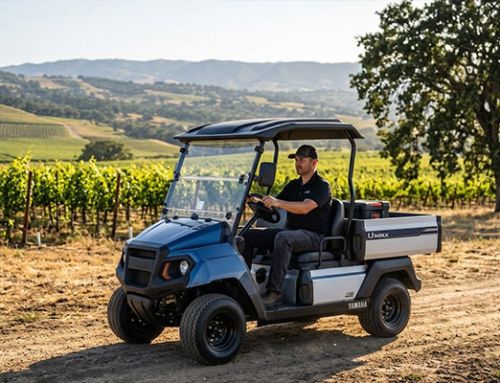
New commercial utility vehicles — particularly purpose-built platforms like the Yamaha UMAX line — represent a significant per-unit investment. When a commercial property needs three, five, or ten vehicles to properly support its operations, that investment compounds quickly. For operations where budget discipline is a genuine constraint, or where leadership needs to justify capital expenditure against measurable operational return, the refurbished market offers a path to building fleet capacity that brand-new pricing often doesn’t.
The value proposition is straightforward: commercial Yamaha vehicles are built to last. A fleet that was properly maintained through its first ownership cycle has meaningful useful life remaining, and that remaining life can be accessed at a price point that makes fleet expansion financially realistic for organizations that couldn’t otherwise justify it. The key, as with any used equipment purchase, is knowing what you’re actually buying.
What a Proper Fleet Inspection Should Cover
The inspection process for a commercial fleet vehicle purchase is more involved than what most buyers expect when they first approach the refurbished market. These are working vehicles that have been under load, operating on variable terrain, and cycling through charging and discharge routines for years. A visual walk-around tells you very little about what matters most. Here’s what a thorough evaluation should address:
Structural and Frame Integrity
The frame is the foundation of the vehicle, and damage here affects everything built on top of it. Look for cracks, stress fractures around weld points, or evidence of straightening repairs following an impact. Pay particular attention to the front end and cargo bed mounting points, which take the most abuse on a working commercial vehicle. Frame compromise that isn’t visible in normal lighting can often be identified during a professional inspection — this is one area where having a trained technician evaluate a vehicle before purchase is worth the time.
Battery System Condition and Age
The battery pack is both the most critical and the most expensive component to replace on an electric commercial vehicle. Age and cycle history matter here as much as current performance — a battery that tests adequately today may be close to the end of its reliable service life if it has accumulated significant cycles or has been improperly maintained. Ask for documentation of battery age and service history, and have the pack tested professionally rather than relying on a charge-and-drive assessment. A weakening battery that performs acceptably on a short test run may not sustain an eight-hour commercial workday under load.
Motor and Drivetrain Condition
Listen for unusual noises during operation — grinding, clicking, or whining that suggests bearing wear or drivetrain issues. Check for smooth, consistent power delivery without hesitation or surging. On cargo variants, put the vehicle under an appropriate load if possible and evaluate how it performs — a drivetrain that feels adequate unloaded may reveal issues when asked to work. The transaxle and differential components on commercial utility vehicles take significant wear in heavy-use applications, and their condition is worth specific attention.
Brake Condition and Adjustment
Commercial vehicles that have operated under load on variable terrain will have more brake wear than lighter-use vehicles. Check for consistent, predictable braking without pulling, grinding, or excessive pedal travel. Cable-actuated brake systems require periodic adjustment as they stretch with use, and a system that’s significantly out of adjustment has usually been that way for a while. Brake service before delivery should be a standard expectation on any refurbished commercial fleet purchase.
Electrical System Integrity
Inspect main cables for fraying or cracking insulation, check connection points for corrosion or heat discoloration, and verify that lights, gauges, and any onboard electronics are functioning correctly. Electrical issues on used commercial vehicles are common, and the ones that aren’t immediately apparent can surface quickly once the vehicle is in regular service.
Cargo Bed and Attachment Compatibility
For cargo and utility variants, inspect the bed surface and structure for damage, confirm that any dump, tilt, or locking mechanisms operate correctly, and verify that mounting points for specialty attachments are intact and compatible with the configurations your operation requires. A cargo bed that’s structurally compromised may not be apparent until weight is applied.
Dealer-Certified vs. Private Seller: Why the Source Matters
The refurbished commercial vehicle market includes a wide range of sources — authorized dealers, general used equipment auctions, fleet liquidations, and private sellers — and the buyer experience and outcome varies significantly across those categories. Here’s what changes depending on where you buy:
Service history and documentation. An authorized dealer can provide the vehicle’s service record and document what reconditioning work was performed before sale. A private seller typically cannot. Buying a commercial vehicle with an unknown service history is buying uncertainty — you don’t know how the battery was maintained, whether brake service was performed on schedule, or what mechanical issues may have been present and unaddressed.
Pre-sale reconditioning. Vehicles that come through our inventory at Gilchrist are inspected and reconditioned by our service team before they’re offered for sale. That process addresses the issues that accumulate on a working commercial vehicle — brake adjustment, battery evaluation, electrical inspection, and worn parts replacement where applicable — so that what we’re selling is a vehicle ready to work, not a vehicle sold as-is and left to the buyer to sort out.
Ongoing service relationship. Purchasing from an authorized dealer means your service relationship continues after the sale. We know the vehicle’s history, we understand its configuration, and we can support it going forward. A private sale ends at the transaction — if something surfaces afterward, you’re managing it without any continuity of knowledge about that vehicle.
Warranty and recourse. The coverage available on dealer-sold refurbished vehicles differs materially from what a private sale offers, which is generally nothing. Contact our team for current details on what’s available on our certified pre-owned inventory.
Matching Configuration to Operational Need
A refurbished fleet purchase is also an opportunity to evaluate whether the vehicle types you’re acquiring actually match what your operation needs — which isn’t always what the previous owner was running. Commercial utility fleets tend to include a mix of:
- Cargo and flatbed variants for equipment transport, supply movement, and facilities logistics work where carrying capacity and bed configuration are the primary requirements.
- Multi-passenger units — including 6-passenger configurations for properties that need to move groups of guests, staff, or individuals with mobility challenges across large grounds.
- Specialty utility builds configured for specific applications such as towing, elevated work platforms, or enclosed cargo needs.
Our post on choosing the right utility vehicle fleet for your commercial property covers the configuration planning process in depth if you’d like to work through your operational requirements before evaluating specific inventory. And if your evaluation ultimately points toward new rather than refurbished, our post on the Yamaha UMAX commercial utility line covers what purpose-built new commercial platforms offer.
To explore our current refurbished commercial inventory or discuss your fleet requirements with our team, visit our used and refurbished golf cars page or reach out directly.
Gilchrist Golf Cars
1140 Tara Ct., Rocklin, CA 95765
916-652-9078
sales@gilchristgolfcars.com
Used & Refurbished Golf Cars | Request a Quote