
5 Clear Signs Your Golf Cart Needs a Professional Tune-Up
Golf cars are dependable machines, and a well-maintained vehicle can run for years without significant issues. But like any vehicle, they communicate when something isn’t right — usually well before a minor problem becomes a costly repair. The challenge is knowing what to listen and look for, and understanding when what you’re noticing is worth a call to your service shop versus something that can wait for the next scheduled maintenance visit.
At Gilchrist Golf Cars, our service team sees a wide range of vehicles come through our Rocklin shop — personal vehicles, commercial utility units, and everything in between. The situations that tend to result in the most expensive repairs are almost always ones where the early warning signs were present for a while before the owner brought the vehicle in. This post covers the five most common indicators we see that a golf car is overdue for a professional inspection.
Sign 1: Sluggish or Inconsistent Acceleration
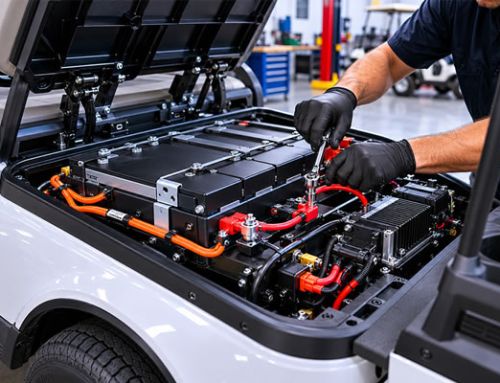
A golf car that hesitates when you press the accelerator, surges inconsistently, or feels noticeably less responsive than it used to is telling you something. On an electric vehicle, sluggish acceleration is often tied to battery performance — either a weakening pack that can no longer deliver the current the controller is asking for, or a battery that is holding less charge than it should. Reasons can vary depending on the manufacturer of the vehicle, but it also can point to issues with the controller itself, motor connections, forward and reverse switch, or accelerator function.
What makes this symptom easy to overlook is that it tends to develop gradually. The vehicle feels a little slower than it used to, but still moves, so it doesn’t register as an urgent problem. By the time the degradation becomes obvious, the underlying issue has usually progressed further than it needed to. If your cart is noticeably less responsive than it was six months ago, that’s worth having looked at — don’t wait for it to stop moving entirely.
Sign 2: Braking That Feels Off
Brake feel changes are another thing owners tend to adapt to rather than act on. A softer pedal than usual, a cart that pulls to one side when braking, a longer stopping distance, a grinding sensation when slowing down, or rapid brake grabbing with minimal pedal pressure are all signs that the braking system deserves attention. Golf car brakes — cable-actuated drum brakes on most models — stretch and wear over time, and the adjustment window between “fine” and “needs service” can be narrower than people expect.
For commercial fleet operators, brake reliability is a non-negotiable safety consideration. A vehicle moving staff, guests, or cargo across an event site or commercial property needs to stop predictably every time. We’d rather see a fleet vehicle come in for a brake adjustment on a regular schedule than have a braking issue surface during an event or active operations.
Sign 3: Unusual Noises During Operation
A golf car running normally is a relatively quiet machine, particularly an electric model. When you start hearing sounds that weren’t there before — clicking, grinding, whining, or rattling during acceleration, turning, or braking — that’s the vehicle flagging a mechanical issue that deserves a closer look.
Clicking or popping during turns often points to the front end — ball joints, tie rod ends, or wheel bearings. Grinding during braking suggests worn brake components. A high-pitched whine during acceleration can indicate motor or drive system issues. None of these sounds resolve on their own, and in our experience, ignoring them tends to convert a relatively straightforward repair into a more involved one. When something sounds different, trust that instinct and have it checked.
Sign 4: Reduced Battery Range or Inconsistent Charge
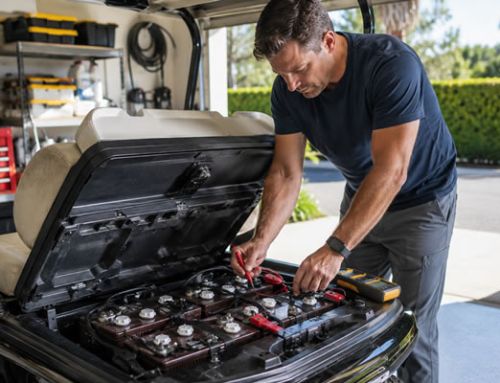
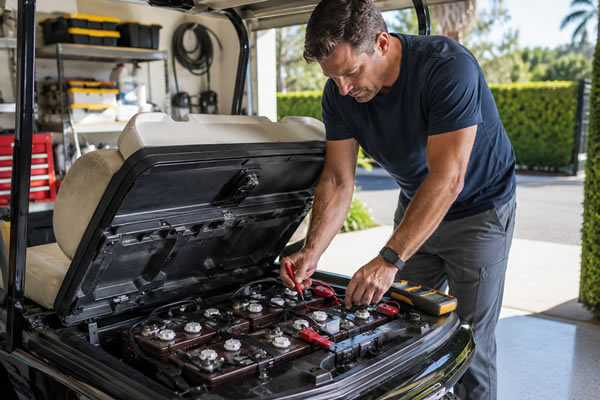
If your cart used to cover your full route on a single charge and now runs out of power before you’re done, or if the battery gauge drops faster than expected, the battery system is worth evaluating. Range reduction on a lead-acid pack is a common sign of aging cells that can no longer hold a full charge — and it tends to accelerate once it starts.
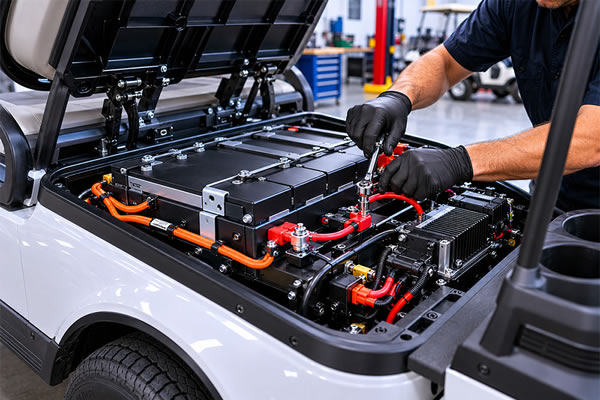
It’s also worth paying attention to how long the battery takes to charge. A pack that charges unusually quickly may not actually be accepting a full charge — it may be indicating cells that have failed and are no longer participating in the charge cycle. A battery evaluation from our service team can tell you whether you’re looking at a maintenance fix, a battery replacement, or a situation where a lithium conversion makes more long-term sense. Our post on lithium versus lead-acid battery upgrades covers that decision in detail if you’d like to explore it further.
Sign 5: Steering That Pulls, Wanders, or Feels Loose
A golf car should track straight and respond predictably to steering input. If yours pulls consistently to one side, feels vague or loose through the wheel, vibrates at speed, or requires constant correction to hold a straight line, the front end needs attention – but always check your tire pressure first to see if that is the simple fix. Steering and suspension components — tie rods, kingpins, spindles, front wheel bearings — wear over time and under load, particularly on vehicles that operate on uneven terrain or carry heavy cargo regularly.
Loose or imprecise steering isn’t just a comfort issue — on a vehicle that operates around pedestrians, event attendees, or in tight commercial spaces, it’s a genuine safety consideration. This is one of the warning signs we most strongly encourage owners and fleet managers to address promptly rather than monitor.
Why Early Action Saves Money
The pattern we see repeatedly in our service shop is straightforward: problems caught early are less expensive to fix than problems that have been running for months. A brake adjustment is a routine service item. A worn component that’s been grinding through adjacent parts for a season is a more complex and costly repair. A battery evaluation that identifies a failing cell early can extend the life of the pack. The same issue left unaddressed long enough may require a full replacement.
Preventive service isn’t just about avoiding breakdowns — it’s about managing the cost of ownership over the full life of the vehicle. Our post on essential maintenance tips for Yamaha golf cars covers the routine habits that help keep these issues from developing in the first place.
A Note for Commercial Fleet Operators
If you’re managing a fleet rather than a single vehicle, the calculus on proactive service becomes even clearer. A vehicle that goes down during an active event, a busy harvest season, or a high-demand operational period costs far more in disruption than a scheduled service visit would have. We work with commercial operators throughout Sacramento and Placer County to keep their fleets maintained on a schedule that fits their operational calendar — not just when something breaks.
If any of the signs above sound familiar — on a single vehicle or across your fleet — reach out to our service department in Rocklin. We’ll take a look, give you an honest assessment, and let you know what the vehicle actually needs.
Gilchrist Golf Cars
1140 Tara Ct., Rocklin, CA 95765
916-652-9078
sales@gilchristgolfcars.com
Service & Repair — Rocklin, CA