
Lithium vs. Lead-Acid: Is It Time to Upgrade Your Golf Car Battery?
If you own a golf car — whether it’s a single vehicle for personal use or part of a commercial fleet — the question of lithium versus lead-acid batteries has probably come up. A few years ago, lithium was considered a premium upgrade that made sense only in specific high-use situations. Today, the conversation has shifted considerably. Lithium battery technology has matured, pricing has become more accessible, and the long-term performance advantages have become harder to ignore.
At Gilchrist Golf Cars, our service team handles battery conversions regularly, and we’ve worked through the lithium versus lead-acid decision with a wide range of customers — individual owners who want better performance and less maintenance, and commercial fleet operators who are running the numbers on total cost of ownership across a large vehicle inventory. The right answer isn’t always the same, but there’s a clear pattern to how the decision tends to land. Here’s what we walk customers through.
Understanding What You’re Comparing
Lead-acid batteries have powered electric golf cars for decades. They work, they’re widely understood, and replacement parts and service are available just about everywhere. For most of that time, lead-acid was the only practical option, and a well-maintained lead-acid pack on a quality vehicle like a Yamaha can give years of solid service.
Lithium iron phosphate (LiFePO4) batteries — the chemistry most commonly used in golf car conversions — are a fundamentally different technology. They’re not simply a better version of lead-acid; they operate differently, charge differently, and require a different approach to integration. Understanding those differences is the starting point for making a good decision.
The Performance Comparison
Weight
This is one of the most immediately noticeable differences. A standard lead-acid battery pack in a 48-volt golf car is heavy — often 300 pounds or more depending on the configuration. A lithium pack delivering equivalent or greater usable energy can weigh a fraction of that. For an individual owner, the weight reduction translates to a more responsive, nimble vehicle. For a commercial fleet, it translates to reduced wear on suspension components, frames, and tires across an entire inventory of vehicles over multiple years of use.
Charging Speed and Flexibility
Lead-acid batteries require a full charge cycle to maintain battery health — partial charging and then leaving a battery in a partially discharged state accelerates degradation. Lithium batteries don’t carry that limitation. They accept opportunity charging naturally, meaning you can top them off between uses without any negative effect on the battery’s long-term health. For commercial operations where vehicles need to be ready throughout the day with limited downtime windows, that flexibility is a meaningful operational advantage.
Lifespan
A well-maintained lead-acid pack typically delivers somewhere between four and six years of useful service life before performance degrades to the point where replacement is necessary — and in high-use commercial environments, that timeline can be shorter. Lithium batteries routinely deliver two to three times the cycle life of lead-acid under equivalent conditions. Over the ownership period of a vehicle, that difference in replacement frequency is a significant cost factor, which we’ll come back to in a moment.
Maintenance Requirements
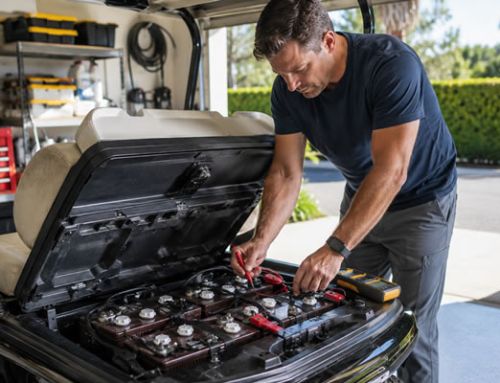
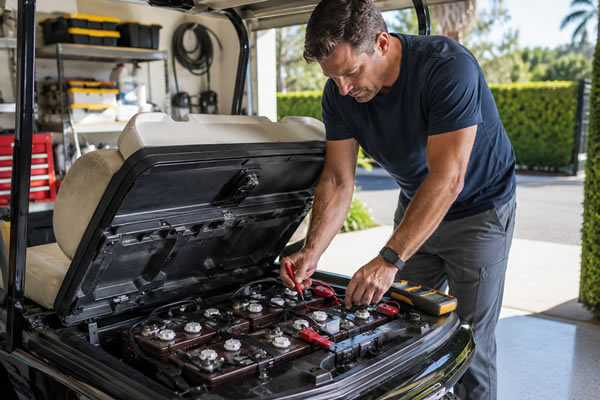
Lead-acid batteries require regular attention — checking and topping off water levels, cleaning terminals, performing equalization charges, and monitoring for sulfation. In a commercial fleet, that maintenance obligation adds up to real labor time across a battery inventory. Lithium batteries require essentially none of that. Once installed properly, they manage themselves through an integrated battery management system (BMS) and ask very little of the owner in return. For fleet operators and individual owners alike, that reduction in routine maintenance is one of the most practically appreciated benefits we hear about from customers who’ve made the switch.
Consistent Power Delivery
Lead-acid batteries experience voltage sag as they discharge — meaning your vehicle performs progressively less well as the charge depletes throughout the day. Lithium batteries deliver consistent power output across the majority of their discharge range, so the vehicle performs at the end of the day much as it did at the beginning. For a personal vehicle, that’s a comfort and performance difference. For a commercial vehicle covering significant ground in a day’s operation, it’s a reliability consideration.
The Long-Term Cost Picture
Lithium batteries cost more upfront — that’s straightforward and worth acknowledging directly. For a single vehicle, the conversion investment is meaningful. For a fleet, it’s a significant line item. The question isn’t whether lithium costs more initially; it’s whether the total cost over the ownership period favors lithium or lead-acid.
When we work through this with commercial fleet operators, the calculation generally includes: the number of lead-acid replacement cycles avoided over the vehicle’s lifetime, the labor cost of lead-acid maintenance eliminated, the reduction in suspension and component wear from the lower battery weight, and the operational value of faster charging and consistent performance. For high-use commercial vehicles, the math tends to favor lithium fairly clearly once you’re looking beyond the first two or three years of ownership.
For individual owners on lower-use vehicles, the calculation is closer, and the decision often comes down to how long they intend to keep the vehicle and how much they value the maintenance-free experience. Brands like Bolt and Eco Lithium offer quality options in this space, and our service team can help you evaluate what makes sense for your specific vehicle and usage pattern.
Why Professional Installation Matters
The battery management system (BMS) needs to be correctly matched to the pack, the vehicle, and often the controller, plus there are firmware improvements that require updating over time as the technology improves. Done improperly, a lithium conversion can create safety risks, void your vehicle’s warranty, and result in a system that underperforms or fails prematurely.
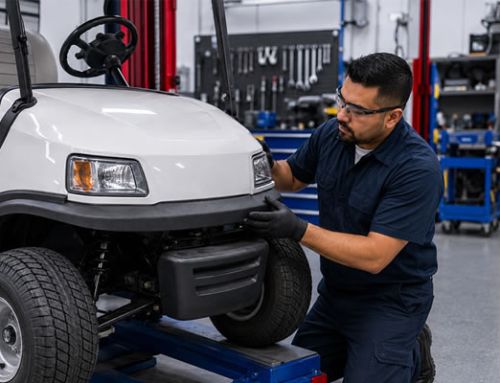
Our factory-trained technicians handle lithium conversions with the diagnostic tools and technical knowledge specific to your specific vehicle. We verify charging system compatibility or replace charging components as required, ensure the BMS integration is correct, and test the system fully before the vehicle leaves our shop. That process protects both the vehicle and the investment you’re making in the upgrade and allows us to provide any future warranty support needed – something you won’t get in a DIY project.
If you’ve been on the fence about making the switch, or if your current lead-acid pack is approaching the end of its service life and you’re evaluating your options, we’re glad to sit down with you and work through what makes sense. You can also read more about how battery health connects to overall vehicle performance in our post on signs your golf cart needs a professional tune-up.
Contact our Rocklin service department to schedule a lithium conversion consultation, or to have your current battery system evaluated before you commit to a direction.
Gilchrist Golf Cars
1140 Tara Ct., Rocklin, CA 95765
916-652-9078
sales@gilchristgolfcars.com
Service & Repair — Rocklin, CA